On 31st of July 2026 Khaled Sayed Gad joined the AURIGA team as a contracted researcher, bringing to the project a specialisation in energy system modelling and decision-making under deep uncertainty.
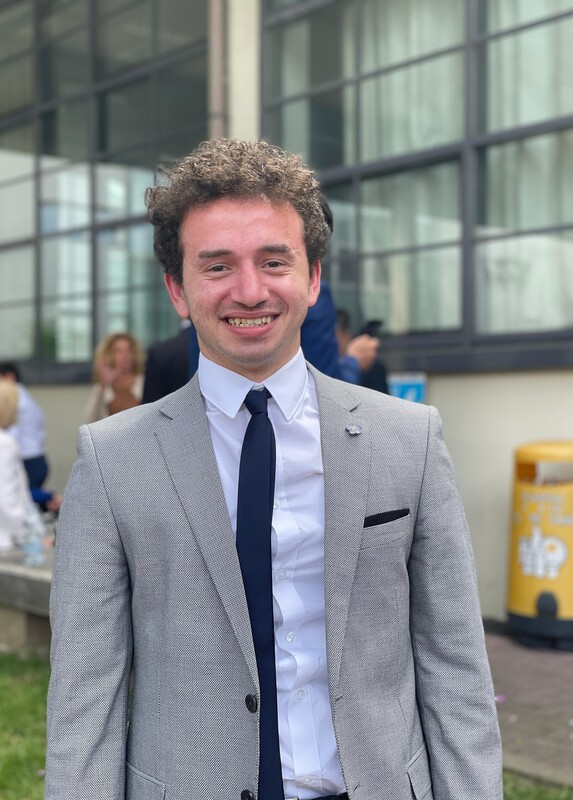
Khaled is a researcher in the SESAM (Sustainable Energy System Analysis and Modelling) group at the Department of Energy, Politecnico di Milano. He holds a doctorate in Science, Technology and Policy for Sustainable Change from Politecnico di Milano, where his thesis developed a holistic protocol for analysing decarbonisation strategies in the transport sector, applied to the Italian railway system. He also holds a master’s degree in Energy Engineering (Energy for Development) from Politecnico di Milano and a bachelor’s degree in mechanical engineering (Power Generation) from Ain Shams University in Cairo, Egypt.
His research integrates energy system optimisation modelling, stochastic bottom-up demand simulation, multi-objective optimisation, and decision-making under deep uncertainty to assess robust decarbonisation pathways across uncertain futures. He is an active contributor to the open-source Hypatia modelling framework and has published on long-term energy planning for Italy, Egypt, and the Nile East Basin, as well as on railway energy demand and decarbonisation scenario analysis. He has been a visiting researcher at Utrecht University, where he applied Exploratory Modelling and Analysis to national energy system models, and has collaborated with Rete Ferroviaria Italiana, the MOST National Centre for Sustainable Mobility, and Eni S.p.A.
In the AURIGA project, Khaled will focus his research on system analysis and national scenario integration. His work bridges the process-level modelling developed in earlier work packages and the broader energy system in which the technology must compete. Where the scale-up and techno-economic sub-models characterise the performance and cost of the ionic-liquid bubble-column absorber at the level of a single industrial installation, Khaled’s contribution asks the complementary question — under which conditions, at what scale, and in which sectors should Italy deploy this technology to meet its climate commitments, and how robust is that answer to deep uncertainties in carbon prices, solvent costs, and competing technology learning rates? To answer it, he will integrate an AURIGA technology node into Italian national energy system optimisation models and apply Exploratory Modelling and Analysis across ensembles of scenarios, translating engineering results into policy-relevant deployment conditions.
More information about Khaled is available on his page in the Team section.