Lab

The experimental campaign

One problem at several scales

A bubble column is designed and operated as a whole, but what it does as a whole is settled at the scale of single bubbles: how fast one rises, how it deforms, whether it drifts sideways, whether two of them merge, how much gas crosses its surface. Inside a working column those mechanisms cannot be told apart, because millions of bubbles are doing all of them at once. The campaign therefore works at two scales — isolating one mechanism at a time in small laboratory columns, then measuring the aggregate behaviour in a large-diameter one — so that what is observed at the top of the column can be traced to the physics underneath it.

Small scale · Work package b and c

Small-scale bubble columns

Six transparent acrylic columns, they differ in the section, in the injector carried on the bottom plate — a needle, rows of needles, and perforated plate — and in the optical access up the height, which is what decides the experiment each one can do. The working fluids range from water to the aqueous ionic-liquid mixtures the project has selected.

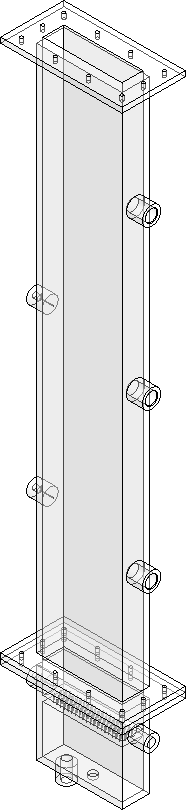
CAD elevation of the single-bubble column

Single-bubble column

A rectangular column releases single bubbles, tracked with a high-speed camera to study how they rise, change shape, and wobble in water and ionic liquid solutions, revealing the basic physics behind bubble behaviour in liquids.
CAD elevation of the rectangular bubble-swarm column

Bubble-swarm column

A rectangular column with perforated plates of different hole sizes generates a controlled bubble swarm, tracked through image analysis and gas holdup measurements to reveal flow-regime behaviour feeding into a broader theory of bubble columns.

CAD elevation of the cylindrical bubble-swarm column

Circular bubble-swarm column

A transparent cylindrical column about 2 m tall, operated with three different spargers, where gas holdup is measured over four axial sections from differential pressure and complemented by local optical-probe measurements, to follow how the gas fraction evolves along the column.
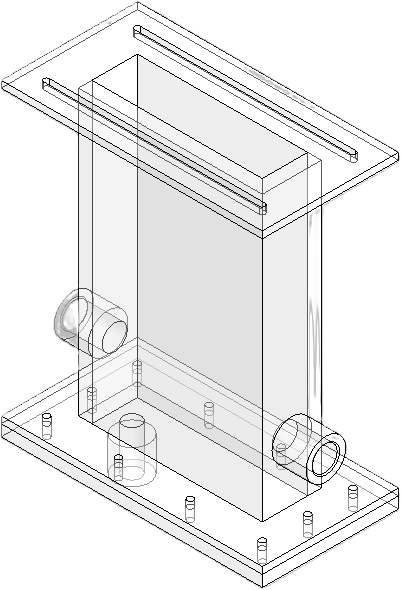
CAD view of the coalescence cell

Coalescence cell

A short rectangular cell is used to study bubble coalescence, where two opposed capillaries nucleate contacting bubbles. High-speed imaging is performed, and coalescence percentage, approach velocity, and coalescence time are quantified through image analysis.
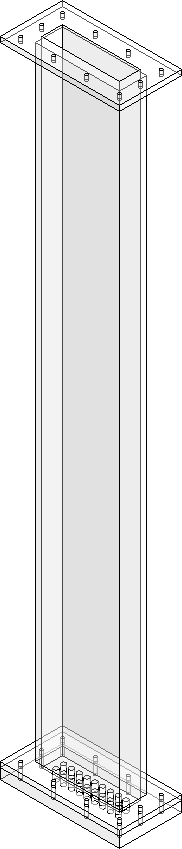
CAD elevation of the CFD-grade column

CFD-grade column

A rectangular column with a controlled injection sparger where each hole can be operated independently, giving measurements clean and repeatable enough to serve as a validation case for the project’s numerical work.
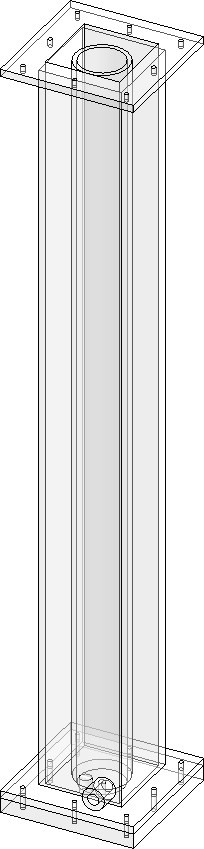
CAD elevation of the mass-transfer column

Mass-transfer column

A 5 cm cylindrical column inside a square outer container, where two synchronized high-speed cameras reconstruct single bubbles in three dimensions and follow their volume as CO₂ is absorbed, giving a direct measurement of the liquid-side mass-transfer coefficient.

Large scale · Work package D

Large-scale bubble column

CAD elevation of the large-diameter bubble column

Large-diameter bubble column

The pilot-scale facility is designed to investigate gas–liquid flow behaviour and CO₂ mass transfer under operating conditions representative of industrial systems. The setup consists of a cylindrical bubble column (0.40 m in diameter and 5.0 m in height), equipped with a counter-current liquid recirculation loop and advanced instrumentation for local and global measurements.

Instrumentation

Instruments and computing resources

The measurement chain behind the two experimental scales, and the computing resources that process what it produces.

Measurement

Wire-mesh sensor

Gas fraction resolved over the whole cross-section of the column, at high acquisition rate, from the conductance between two crossing planes of wires.

Measurement

Optical probes

Local measurements at a point in the flow. Dual-tip probes give void fraction, bubble chord length and bubble velocity from the time each tip spends in the gas; Doppler probes give the velocity of the dispersed phase without touching it, from the frequency shift of the backscattered light.

Measurement

High-speed cameras

Phantom and FLIR cameras record the flow at high frame rate — the images behind Particle Shadow Velocimetry, bubble tracking, and the size, shape and velocity statistics drawn from them.

Measurement

Conductivity meter

For the measurements of the electrical conductivity of the liquid phase, which is related to the CO₂ uptake and impurity content.

Measurement

pH meter

pH of the liquid phase, monitored alongside conductivity while the solvent mixtures are prepared and while they take up CO₂.

Computing

NVIDIA H200 GPU

The compute behind the numerical side of the project: simulations and the image-analysis pipelines that turn recordings into bubble statistics.