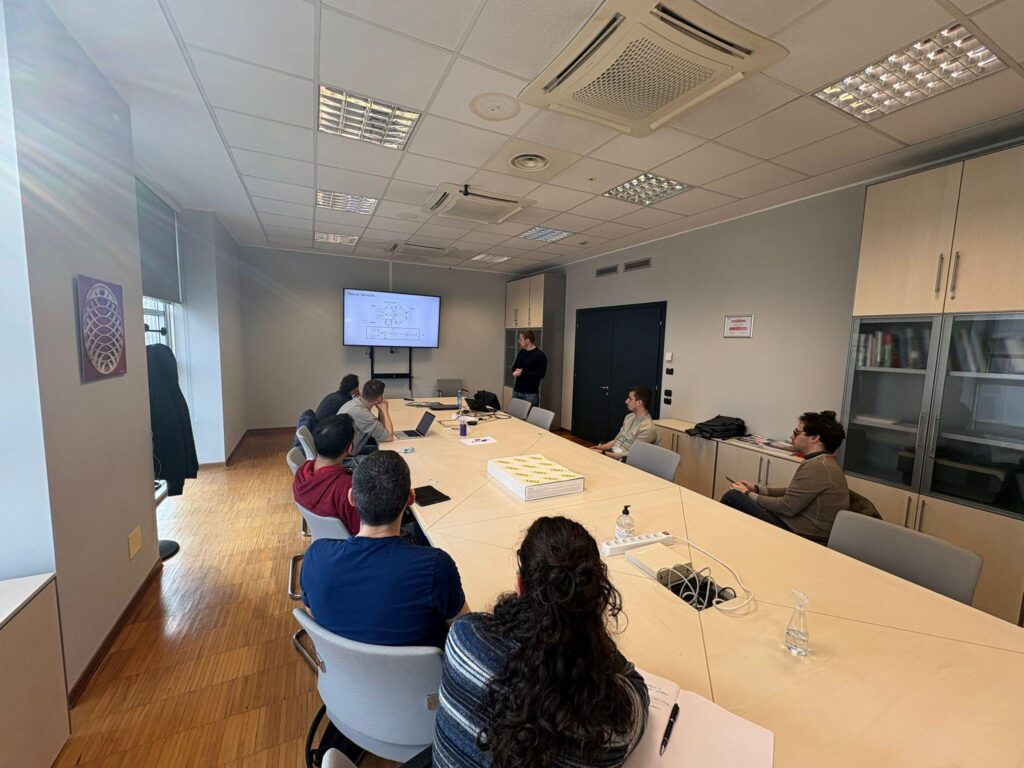
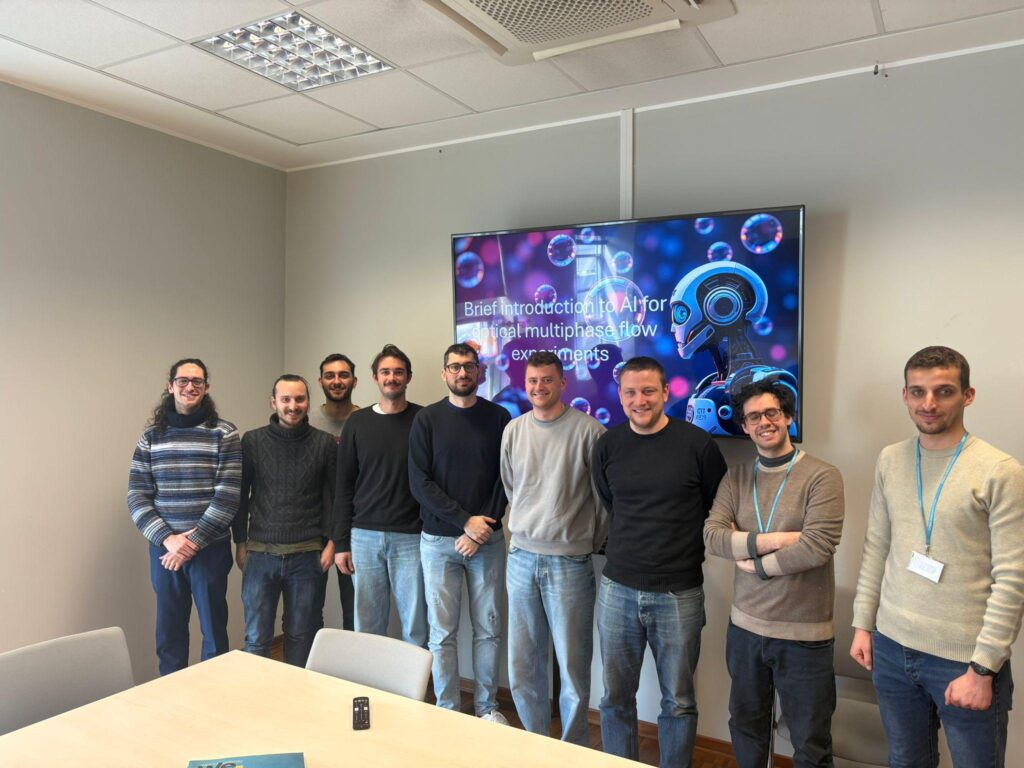
On the 4th of February Dr. Hessenkemper started a three week visiting period to share his expertise on experimental techniques for bubble-image analysis and give a seminar on AI methods for optical multiphase-flow experiments.
Why the technique matters here
Particle Shadow Velocimetry is a direct in-line illumination method: the bubbles and the tracer particles are back-lit and recorded as shadows, so the liquid velocity field around a bubble and the motion of the bubble itself come out of the same set of images. For AURIGA this is the key measurement of the bubble-scale work package — the lift force acting on a rising bubble cannot be obtained from the trajectory alone, but only from a lateral force balance that needs the surrounding liquid velocity as an input.
The seminar dealt with the AI methods that make the technique workable in dense conditions: automated detection, segmentation of overlapping bubbles and tracking across frames, which is what turns a high-speed recording into bubble size, shape and velocity statistics rather than a set of pictures. The discussion covered how to transfer the approach to the aqueous ionic-liquid solutions used in the project, where interfacial mobility differs from pure water and changes both the bubble shapes and the sign of the lift force.
The collaboration has continued since: Dr. Hessenkemper is a co-author on the single-bubble poster awarded at CHISA 2026, and the approach underlies the lift-force campaign carried out at HZDR.